
Student Spotlight: Jack Arena
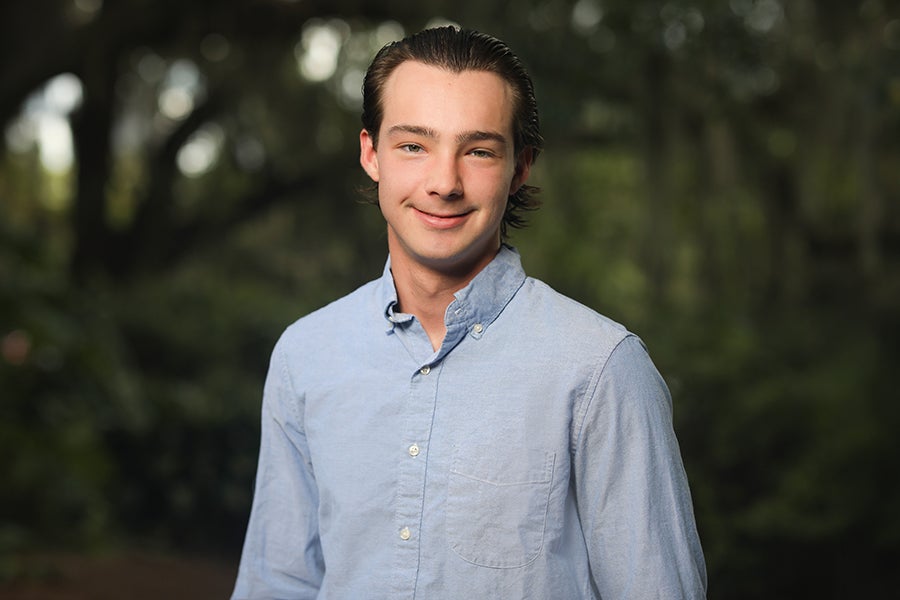
Jack Arena is a Florida State University senior pursuing a degree in chemistry from the Department of Chemistry and Biochemistry, part of the College of Arts and Sciences. Arena serves as president of the American Chemical Society Student Chapter at FSU and served as an Undergraduate Research Opportunity Program leader within FSU’s Center for Undergraduate Research and Academic Engagement from 2025 to 2026. In 2025, Arena participated in the National Science Foundation Research Experiences for Undergraduates program and helped identify nano- and microplastic particles from plastic bottles in water samples at the University of Nebraska-Lincoln, studying plastic’s growing environmental impact. In Summer 2026, he researched materials for energy storage applications as part of another NSF REU at the NSF-funded, FSU-headquartered National High Magnetic Field Laboratory, where he worked alongside National MagLab scientists and presented his work on polymer blend electrolytes.
Tell us about your background, where you’re from, and what brought you to FSU.
I’m from a smaller town in South Jersey, 25 minutes outside of Philadelphia, Pennsylvania. I was looking for a school in the South with nicer weather. I toured a few schools, but FSU had the most beautiful campus. They have a great chemistry program, and the department’s building was very cool. I also played tennis in high school, and the tennis courts are right next to it.
What inspired you to pursue a degree in chemistry?
People often pursue a field they’re naturally drawn to, but chemistry was one of my most difficult courses in high school. The difficulty I faced learning chemistry, paired with my interest in understanding what makes up the stuff in the world around us, helped me make my decision.
Break down your research areas for us.
I started conducting research in UROP my sophomore year, studying the effects of storage temperature, duration, and method on the chemical compounds in baby spinach. I transitioned into environmental research at the University of Nebraska, Lincoln, studying how to detect nano- and microplastics from plastic bottles in water samples.
My current research looks at batteries and polymer blend electrolytes. I combine different types of polymers to see if they can conduct ions. With batteries, there’s a demand for more energy. We always hear about lithium-ion batteries, which are flammable, posing safety risks. We’re trying to develop safer batteries by using solid-state electrolytes instead of liquid electrolytes.
Tell us about your experience working in the NSF–funded REU at the National MagLab.
I started with Teng Ma Endowed Professor of chemical engineering Daniel Hallinan, Jr. in the Polymers for Advanced Energy, Sustainability Lab at the FAMU-FSU College of Engineering in Fall 2025 after my Summer 2025 REU. I was grateful to be funded by the National MagLab for my Summer 2026 REU. The support from the program leaders allowed me to get to know the National MagLab more.
REU is a great program that connected me with researchers and undergraduate students from all over the country.
You co-authored a paper in Applied Food Research on how storage conditions affect the nutritional qualities of baby spinach. How can the public benefit from your work?
The paper covers an interesting concept: We all eat food, but our bodies interact with it differently because we’re not all the same, physiologically. When influencers online talk about health, it is easy to assume ‘if I eat this food, it’s going to have a certain effect.’ That’s not necessarily true because we all process food differently. Things like temperature, additives, and storage duration of food items affect whether you receive the same nutrients as someone who eats it fresh.
How have your leadership roles as president of the ACS Student Chapter at FSU contributed to your overall educational experience?
I stepped into the role of president this semester, and we’re working on boosting our programming. We attended the ACS National Meeting and Exposition last year for the first time, and we’re hoping to bring more people to New Orleans, Louisiana, for the next conference in the spring. We host faculty presentations to expose students to their research and planned a big initiative for National Chemistry Week that took place Oct. 18-24. I’m excited to help our chapter grow and become sustainable long-term.
What on-campus resources have helped you achieve success?
The UROP program was the bridge that guided me to becoming a researcher.
I have worked at the FSU Lakefront Park & Retreat Center since I was a freshman, and I served as vice chair of the campus recreation board. I've been in different classes and had different friends, but Lake Bradford has always been that place I could go to reset.
What are some current goals or projects you’re working on?
I’m pursuing honors in the major this year, continuing to work on battery research with professor Daniel Hallinan and FSU professor of chemistry and biochemistry Justin Kennemur. As ACS president, I’m continuing to boost programming while applying to grad school to pursue a chemistry doctorate.
Are there any faculty or staff who have helped or inspired you?
I want to shout-out professor Daniel Hallinan, my current principal investigator for my lab, and professor Kennemur because I switched around my schedule to take his polymer chemistry class my junior year. The foundations established in that class have led me to where I am now. I’d like to thank UROP undergraduate research support specialist Kris Ryan, FSU assistant professor of chemistry and biochemistry Bryan Kudisch for helping me lead the ACS chemistry chapter, and Jordan Ripka Dailey, coordinator for Lakefront Operations & Challenge.
Even though you might miss FSU, what are you looking forward to once you graduate?
I’ll always cherish my undergraduate career at FSU, but I’m looking forward to dedicating more time to research. I’m applying to Ph.D. programs in chemistry, materials science and polymer science. I’ve grown to enjoy the polymer field and how we can design them for sustainability. I hope to lead my own team of researchers one day.