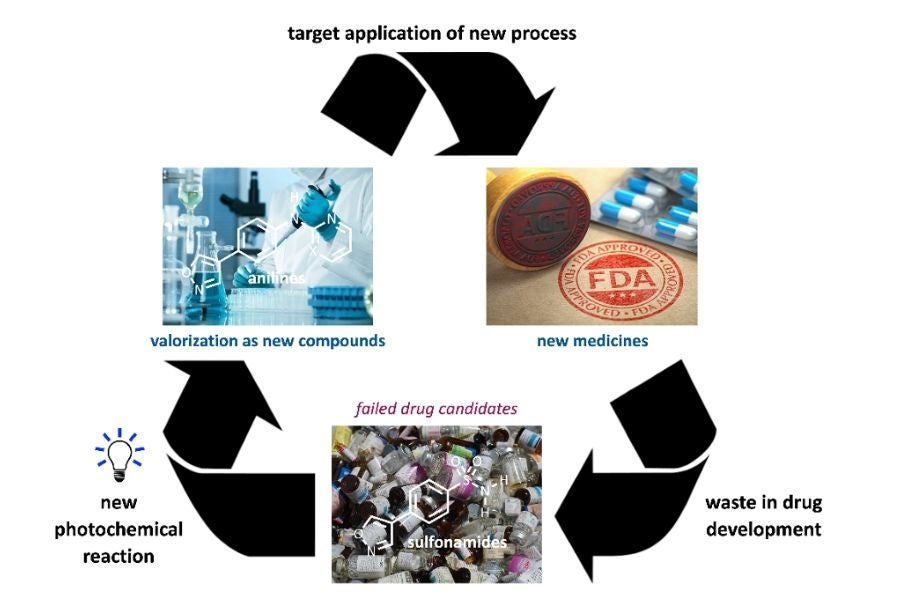
Throughout the drug development process, which can take a decade or more, tens of thousands of chemical compounds are produced that never go on to become medicines. A Florida State University researcher is part of a team that has discovered a new way to give some of these “dead-ends” a second chance at becoming the foundation for tomorrow’s blockbuster drugs.
Assistant Professor of Chemistry and Biochemistry Bryan Kudisch and his collaborators have developed a light-powered chemical reaction that can transform a difficult-to-repurpose class of compounds known as sulfonamides into useful building blocks for future drug discoveries. Their research was published in Journal of the American Chemical Society.
“Dr. Kudisch is a molecular spectroscopist who develops and applies laser-based techniques to measure extraordinary short time processes, particularly chemically important processes induced by light,” said Wei Yang, Department of Chemistry and Biochemistry chair. “His work demonstrates both exceptional technical ability and extraordinary insight to some of the most fundamental and complex processes in chemistry. This publication addressed an important problem closely related to drug discovery, which is a major strategic area of the FSU ASPIRE initiative.”
A target for repurposing compounds
Sulfonamides — which appear in and give rise to the name “sulfa drugs” — are one of the most important molecular substructures in medicinal chemistry. These synthetic medications were some of the first widely used antibiotics almost 90 years ago. Today, they’re still used and found in a variety of medicines that treat diseases and symptoms including Type 2 diabetes, high blood pressure, HIV and melanoma.
Despite their usefulness in many pharmaceuticals, sulfonamides are difficult to repurpose because they are chemically inert. Chemists have developed recipes to interconvert many other functional groups that change the biological properties of a compound, but relatively few options are available to do this with sulfonamides — especially for the sulfur atom that lies at the center of these substructures. Removing this atom or replacing it with a new chemical group could allow researchers to create new versions of existing compounds while preserving their other useful features.
Kudisch and his collaborators addressed this challenge by using a photochemical reaction that converts sulfonamides into anilines, a different class of chemical compounds that serves as the foundation for some cancer-fighting medicines. By transforming part of the molecular structure, otherwise dead-end compounds once again become potential starting points for developing new medicines.
“This outcome was achieved through a chemical ‘surgery’ that uses light to excise a sulfur atom from a sulfonamide,” Kudisch said. “We’re optimistic these types of photochemical surgical tools could underpin a range of powerful processes for reshaping molecules that could advance the development of new medicines.”