
Faculty Spotlight: Biwu Ma
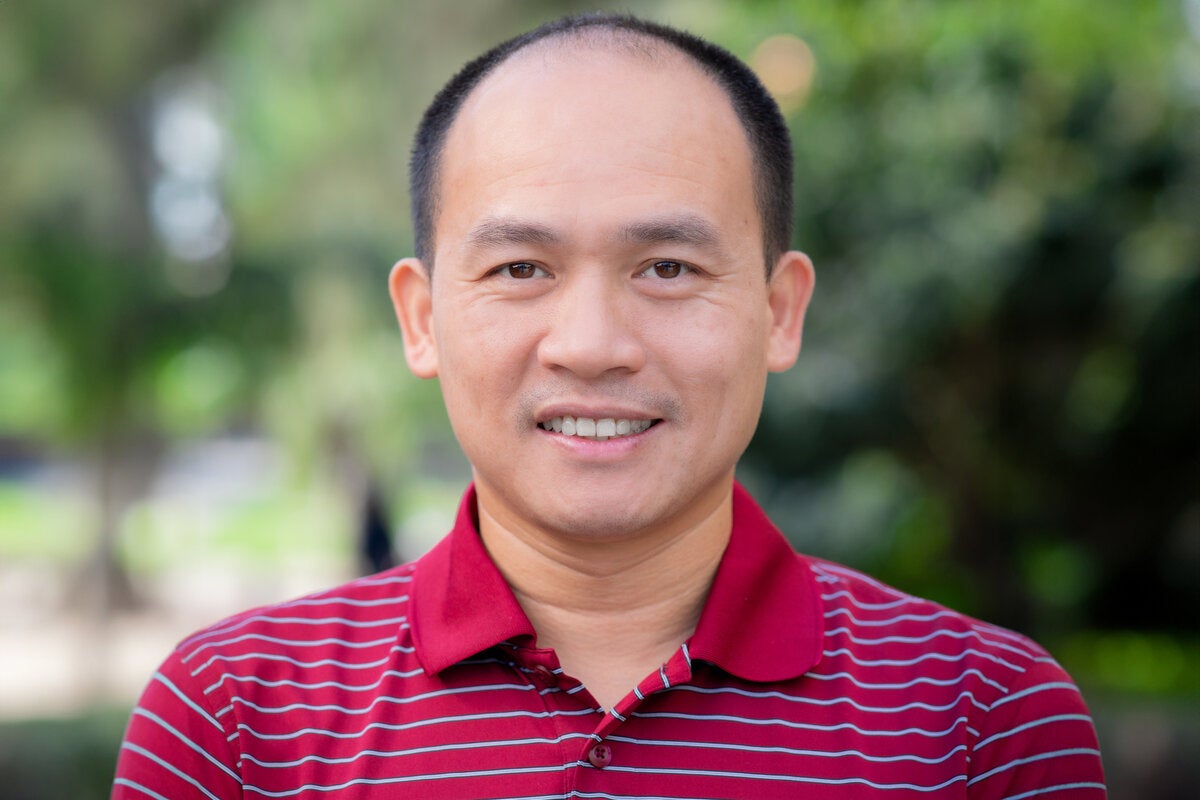
Biwu Ma is a professor in Florida State University’s Department of Chemistry and Biochemistry, part of the College of Arts and Sciences, and an affiliated faculty member with the Materials Science and Engineering Program in the FAMU-FSU College of Engineering. Ma develops new functional materials for applications in areas including energy, medicine, environmental and information technologies and more. After earning his doctorate in materials science from the University of Southern California, Ma conducted postdoctoral research at the University of California, Berkeley. He then worked at the Lawrence Berkeley National Laboratory before joining FSU’s faculty. Ma will conduct research at the University of Antwerp in Belgium during the 2026-2027 academic year through his Fulbright U.S. Scholar Award, merging materials science with medical physics to improve radiation monitoring for cancer treatments.
Tell us about your background and what brought you to FSU.
I grew up in China and came to the United States in August 2001 to pursue graduate studies. After earning my doctorate in December 2005, I conducted postdoctoral research at UC Berkeley and the LBNL from January 2006 to May 2008. I was a staff scientist at the Molecular Foundry at LBNL for five years before coming to FSU in August 2013 through the university’s Strategic Faculty Hiring Initiative in Energy & Materials. I’ve been fortunate to build a wonderful research group and develop collaborations across FSU and the world while working with talented students and researchers.
Break down your research.
I create new functional materials with properties that can be controlled at the molecular level. My group is interested in metal halide perovskites and organic metal halide hybrids, or OMHHs, which are made up of a combination of organic and inorganic components. This allows us to control the materials’ structures and their optical, electronic, and radiation-response properties.
Our work spans fundamental materials chemistry and photophysics through practical device applications, and radiation detection and imaging have become important directions. We synthesize new materials, determine their structures, study how they interact with light and radiation, and incorporate them into technologies like LEDs, solar cells, direct X-ray detectors, and scintillators — materials that convert X-rays or other high-energy radiation into visible light.
What inspired you to choose this field?
I’ve always been fascinated by the connection between molecular structure and material properties and how changing a material at the atomic or molecular levels can change how it behaves. That ability to understand materials and use that knowledge to create new technologies is what drew me to the field and continues to motivate my research.
Tell us about the range of applications in your research.
People may not realize it, but materials science is everywhere: in LED lighting, smartphone and television displays, solar panels and semiconductor technologies. Some applications are less obvious, like scintillators and semiconductors that detect X-rays directly. These materials are used in medical imaging, cancer treatment, airport and security screening, industrial inspection, nuclear science and scientific instrumentation.
Tell us about your Fulbright Award and what this research will investigate.
This award allows me to work with researchers at the University of Antwerp in person to develop advanced radiation dosimetry, particularly for emerging cancer treatments such as ultra-high dose rate, or FLASH, radiotherapy. My group at FSU pioneered a new class of scintillation materials called zero-dimensional, or 0D, OMHHs. We’ll optimize and evaluate these materials as fast, tissue-equivalent and flexible sensors that measure radiation doses in real time. We hope to develop better dosimetry technologies that enable safer and more precise cancer treatment, while strengthening scientific and educational exchange between FSU and our Belgian partners.
What do you want the public to know about the importance of your research?
When creating a material in the laboratory, its application isn’t always obvious. However, a new combination of optical, electronic or radiation-response properties can lead to possibilities that didn’t previously exist. My group developed OMHHs to understand how their structures influence luminescent properties, leading us to discover highly efficient materials for X-ray scintillation and radiation detection — this shows how fundamental research leads to technologies with real benefits for health and society.
What’s your best memory from working at FSU?
My favorite moments are when students approach me with unexpected experimental results and we realize we may have discovered something new. Early in our work on low-dimensional OMHHs, we explored structures and properties different from conventional materials, and some of those results developed into major research directions for our group.
Ultimately, the most rewarding memories are watching students grow. Seeing a student publish a paper, complete a doctorate, or step into a successful career gives me a different kind of satisfaction from publishing research. Those moments remind me that our most important long-term contributions as faculty members are the students we educate.
Who are your role models?
My doctoral adviser, USC professor Mark Thompson, taught me how to connect fundamental molecular photophysics with important technological problems. His pioneering work on phosphorescent OLEDs helped revolutionize the display industry and had a lasting influence on how I approach materials design. My postdoctoral adviser, UC Berkeley professor emeritus Jean Fréchet, broadened my perspective through his research spanning polymer chemistry, biomedical science, and organic electronics, while teaching me the importance of creativity and collaboration. Both showed me how fundamental science enables transformative technologies with far-reaching societal impact while inspiring the next generation.
What’s your favorite part of your job?
Research is exciting because we discover new materials and phenomena, but seeing students develop ideas, overcome challenges, and gain confidence is even more rewarding. Discovering new science while helping young researchers become confident, creative and independent scientists is my favorite part of the job.
If your students only learned one thing from you (of course, hopefully they learn much more than that), what would you hope it to be?
I hope they learn to think independently and approach challenges with curiosity and persistence. Experiments fail, hypotheses prove wrong, and sometimes the most important discoveries begin with results that don’t make sense. I encourage students not to be discouraged, ask why, think critically and keep searching for answers. If my students leave with that mindset, I feel I’ve succeeded.