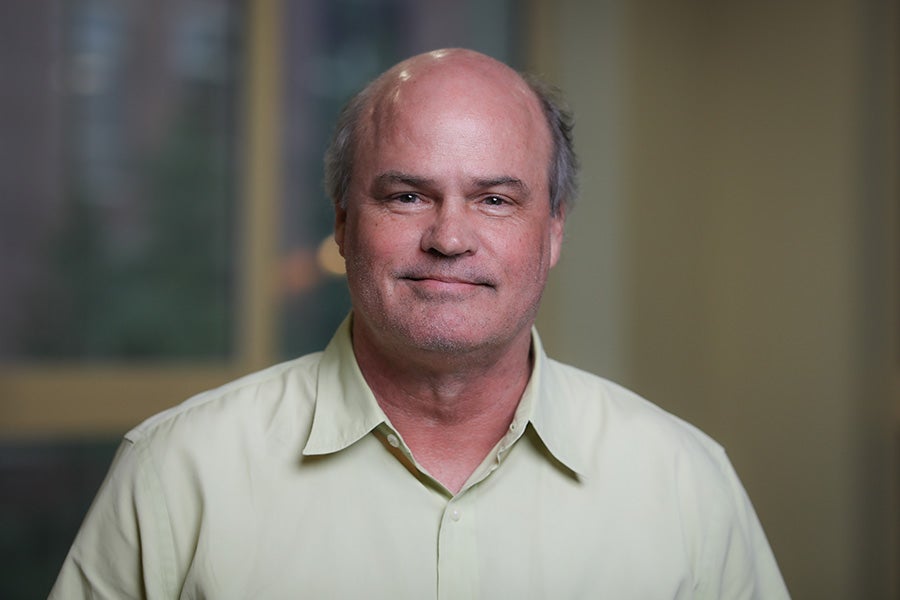
As Suicide Prevention Month brings renewed national attention to mental health, Florida State University Robert O. Lawton Distinguished Professor of Psychology Thomas Joiner stands among the nation’s most influential researchers, dedicating his career to understanding why people die by suicide and how communities can help prevent it.
Suicide remains a leading public health challenge in the United States, with the Centers for Disease Control and Prevention (CDC) reporting 48,824 deaths by suicide in 2024. Each September, organizations including the National Alliance on Mental Illness (NAMI), the Substance Abuse and Mental Health Services Administration and the 988 Suicide & Crisis Lifeline use Suicide Prevention Month to raise awareness, reduce stigma and encourage people to seek help before a crisis becomes fatal.
For Joiner, the inspiration to fully understand and prevent suicidal behavior came from both an intellectual curiosity and a personal understanding.
“I found it intellectually fascinating at first,” Joiner said of getting involved with suicide prevention. “It basically gets to a really fundamental question of the meaning of life. And then it got very personal, because my dad died in that fashion when I was a young person. I think it's driven me ever since; that was 30 plus years ago, and I'm still at it.”
Joiner has made some of the field’s most significant contributions, developing the Interpersonal Theory of Suicide in 2005. The theory identifies three factors that help explain why people may engage in suicidal behavior: feeling like a burden to others, experiencing social disconnection and moving past one’s natural instinct of self-preservation to commit a suicide attempt.
That framework has become especially resonant during Suicide Prevention Month, when public health leaders emphasize that prevention is not only about crisis response, but also about building connection, belonging and a sense that every person matters. Joiner’s research suggests that suicide risk is deeply tied to whether people feel valued, needed and connected to others.
“It really casts suicide as largely a disruption, a dysregulation, in relating and social relating, feeling like you matter to others, feeling like you're connected to others," Joiner said.
According to NAMI, 5.5% of U.S. adults have serious thoughts of suicide each year. Joiner, who directs the Laboratory for the Study and Prevention of Suicide-Related Conditions and Behaviors, has worked extensively with military members and first responders through federally funded initiatives, including the Department of Defense-funded Military Suicide Research Consortium, which aims to reduce suicide risk among service members.
In his three decades exploring a complex field, Joiner continues asking two overarching questions that many other psychologists are left wondering.
“Why would somebody choose that? And secondly, what can we do to prevent it? Those, to me, are the kind of holy grail questions of the field,” Joiner said.
Having developed a foundational framework in contemporary suicide research, Joiner’s influence extends beyond academia into clinical practice and public health policy. One area that encourages him is the growing willingness of others to talk openly about mental health, a shift he believes can help people experiencing suicidal thoughts reach out to others, including health care providers, family members and trusted support networks.
“I think an openness about mental health in general is really important,” Joiner added. “I'm encouraged that we're making progress societally in that mental health fluency way, the kind of openness and literacy and fluency about mental health that simply didn't exist when I was a young person.”
Public misconceptions can make suicide harder to discuss and prevent. Joiner points to harmful myths — including the idea that suicide is an act of cowardice, that it always happens without warning or that it is simply the result of drugs or alcohol — as barriers to better understanding, earlier intervention and more compassionate conversations.
“One (misconception) is that it comes out of the blue and hits people without much warning,” Joiner said. “It can seem that way, certainly from the outside, but I'm just not convinced that ever really happens in their true selves.”
Joiner’s research in an area of critical need has positioned FSU as a national leader in psychology, suicide prevention and mental health scholarship. After three decades on campus, he said that mission is inseparable from the public service role of FSU.
“This is a state university. I really believe that we're beholden to the citizens of the state of Florida,” Joiner said. “They've been so supportive of this university and in turn, this university has been so supportive of me. I'm so glad I came here.”
As Suicide Prevention Month calls communities to help break silence, reduce stigma and strengthen connections, Joiner’s work offers a hopeful and urgent message: suicide prevention begins long before a moment of crisis. Through research, teaching and service at FSU, he continues to advance a field built on the belief that understanding saves lives, and that compassionate conversations can help more people find the support they need.
If you or someone you know is experiencing suicidal thoughts, there are resources available:
- The 988 Suicide & Crisis Lifeline is available 24/7/365 with caring counselors who are available for confidential conversations. Dial 9-8-8 to reach the lifeline.
- The FSU Psychology Clinic is a mental health service, training and research center operated by FSU’s Department of Psychology. They can be reached at (850) 644-3006.