
Student Spotlight: Kaylyn Myers
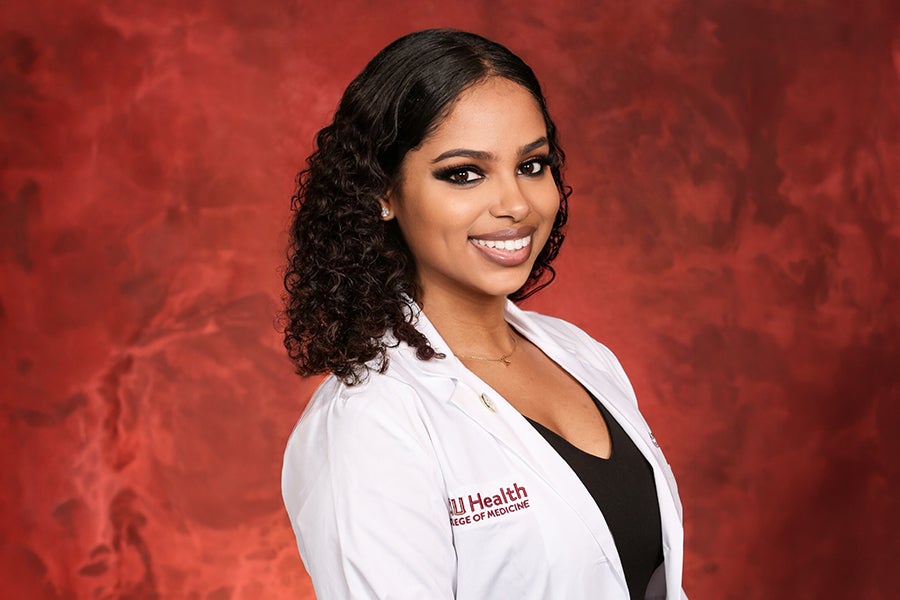
Kaylyn Myers is a Florida State University College of Arts and Sciences alumna who earned a bachelor’s in biochemistry from the Department of Chemistry and Biochemistry in 2025. As an undergraduate, Myers earned certifications in life-support for health care providers and first aid. In 2021, she began working under assistant professor of biomedical sciences Antonia Nemec as an undergraduate medical research assistant in the College of Medicine, where Myers is now a second-year medical student.
What inspired you to pursue a degree in biochemistry?
I chose biochemistry because I've always been drawn to understanding how things work at the molecular level and how small changes in the body can lead to major effects on health and disease. Biochemistry sits at the intersection of chemistry, biology and medicine. It challenged me, but it also provided a foundation for understanding the science behind patient care, which became especially important as I worked toward medical school.
Can you tell us about an impactful experience during your undergraduate studies?
Getting involved in research showed me how to apply what I was learning in class to practical scientific questions. It taught me that science isn’t just memorizing equations or mechanisms. It’s about asking thoughtful questions, troubleshooting when things don’t go as planned and staying curious. My research experience helped me develop resilience, build confidence, and showed me how much I enjoy learning through discovery.
Describe your experience as an undergraduate medical research assistant.
As an undergraduate medical research assistant, I worked under Antonia Nemec in the FSU College of Medicine’s Department of Biomedical Sciences. This was a hugely formative experience which taught me how to think like a researcher. I learned technical and analytical skills but also how to approach problems, ask better questions, and communicate complex ideas clearly. Dr. Nemec was especially good at explaining difficult concepts in a way that made them understandable. She created an environment where I felt supported while still being challenged to grow.
What motivated you to pursue medical school?
I pursued medical school because I wanted a career that combines science, service and human connection. Through research, volunteering, and community health work, I saw that medicine depends on trust, communication and advocacy as much as knowledge. I wanted to be in a position where I could use my scientific background to help people directly, especially communities facing barriers to care. Medical school felt like the path that would allow me to bring all those interests together.
How did your time in the College of Arts and Sciences prepare you for success in the College of Medicine?
My time in the College of Arts and Sciences gave me a strong scientific foundation and taught me how to think critically. The coursework was rigorous, but it helped build the discipline and problem-solving skills I needed. Beyond academics, my experiences in research, leadership, and service helped me become more confident, adaptable, and comfortable working with different people. Those skills have been just as important in medical school as science itself.
What do you want the public to know about the importance of your work?
Research and community health work are deeply connected to real people’s lives. Whether it’s biomedical research in a lab or community-based work focused on access to health care, the goals are to improve care, reduce barriers, and better understand the needs of patients and communities. Sometimes the impact of research isn’t immediate, but each project contributes to a larger effort to make health care more effective, equitable and responsive.
Are there any faculty or staff members who inspired you?
One faculty member who has truly inspired me is my former research mentor, Dr. Nemec. I worked with her for four years, and I was inspired by the way she balanced so many responsibilities while still being an incredible teacher and mentor. She had a gift for explaining complex concepts in plain language, and she was always able to come up with thoughtful, creative ideas. Watching the way she approached science, mentorship, and problem-solving had a major impact on the way I navigate my studies in medical school.
What are some upcoming goals or projects you are working toward?
I’m focused on continuing to grow in medical school, building my clinical and research experiences, and staying involved in community-based work. I’m especially interested in ophthalmology — the branch of medicine that deals with the anatomy, functionality, and diseases of the eye — and health equity. I hope to continue working on projects that connect patient care, research and access to services. I’m also looking forward to continuing to develop as a leader and mentor for students who are navigating similar paths.
What advice do you have for current students?
My advice to current students is to stay open to new opportunities, even if you don’t know yet where they will lead. Some of my most meaningful experiences came from saying yes to something that challenged me or pushed me outside of my comfort zone. I would also tell students not to be afraid to ask questions, seek mentorship, and advocate for themselves. You don’t need to have everything figured out immediately. Growth takes time, and the experiences that feel difficult in the moment often end up shaping you the most.