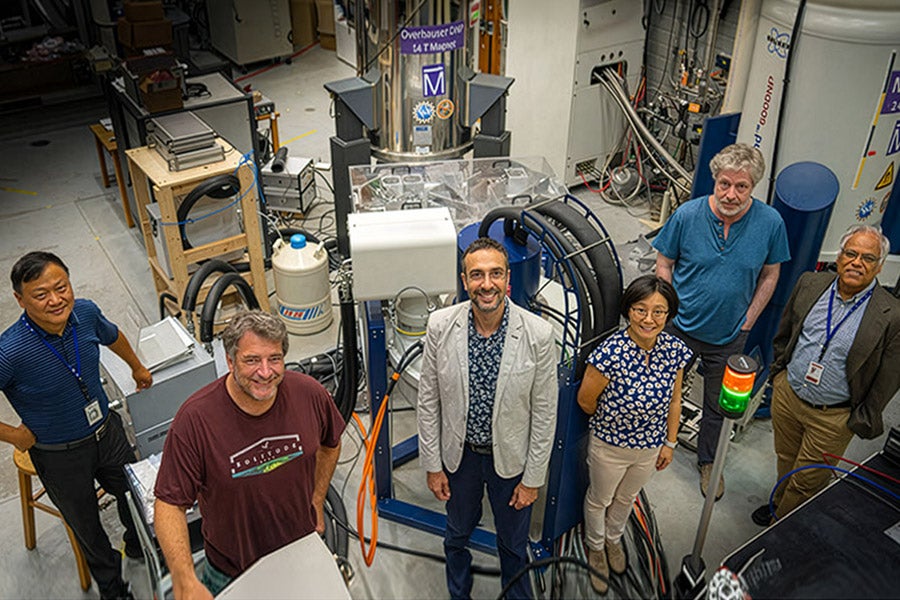
The project to create an advanced nuclear magnetic resonance facility supports U.S. National Science Foundation priorities in biotechnology, energy, advanced manufacturing and health.
The Florida State University-headquartered National High Magnetic Field Laboratory, or MagLab, is launching a new magnet facility to build on its world leadership in nuclear magnetic resonance with $18 million in funding from the National Science Foundation.
The new ultra-high-sensitivity facility will center around a new 23.5-tesla nuclear magnetic resonance, or NMR, magnet, one of the strongest in the United States, complemented by additional equipment to accelerate data acquisition for a wide range of research.
“This grant will fund an instrument that is unique in the world. It's a significant milestone and exciting news for the MagLab, FSU and the U.S. as a whole,” said Frederic Mentink-Vigier, lead researcher for the project and an affiliated faculty member in the FSU Department of Chemistry and Biochemistry. “What this instrument is opening up is the ability to look at samples with higher sensitivity, and thus to look at the entirety of the periodic table.”
With stronger magnets, researchers can make deeper investigations to drive breakthroughs across disciplines.
“This facility will provide previously inaccessible capabilities for understanding the structure and dynamics of matter at the atomic scale, critical to U.S. priorities in biotechnology, energy, advanced manufacturing and health,” said the NSF award announcement.